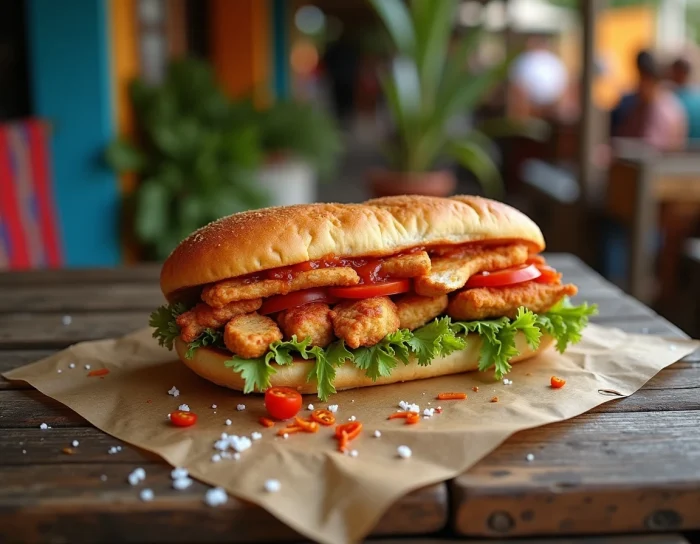
The Guadeloupean bokit is one of those preparations whose culinary genealogy remains disputed, but whose symbolic status continues to grow. Fried bread filled, sold for decades at roundabouts and parking lots in Guadeloupe, this sandwich crystallizes questions that go beyond the simple recipe: family transmission, territorial marketing, contested authenticity. Understanding the bokit today means measuring the gap between a little-documented daily use and an increasingly visible heritage staging.
Bokit and culinary heritage: between local use and tourist showcase
The bokit occupies a unique place in Caribbean gastronomy. It functions both as an everyday food, accessible for a few euros at Guadeloupean food trucks, and as a cultural symbol mobilized in the tourist communication of the archipelago.
This dual function creates tension. On one side, Creole families perpetuate preparation gestures passed down over several generations, with variations in dough, cooking, and filling unique to each household. On the other, the promotion of the bokit in travel guides and social media tends to freeze its image around a standardized version.
Several recent contents now treat the bokit as a heritage and identity marker rather than just a simple street snack. This semantic shift deserves observation: it reflects a desire to enhance Creole cuisine, but also a risk of erasing real practices in favor of a smooth narrative.
To better understand the origin of the bokit on Chapeau Melon, one must trace back to the colonial circulations between English-speaking Caribbean and French-speaking Guadeloupe, a journey that explains why the word itself bears traces of several languages.
Etymology and lineage of the bokit: a table of hypotheses
The origin of the word “bokit” is the subject of several competing narratives. None has definitive academic validation, but their comparison sheds light on cultural circulations in the Caribbean.
| Hypothesis | Language lineage | Associated geographic area |
|---|---|---|
| Derivation from “bucket” | Colonial English to Guadeloupean Creole | Guadeloupe |
| Adaptation of “johnny cake” | Journey cake (English) to johnny cake then bokit | New England, Louisiana, Caribbean |
| Relation to English “bakes” | Bakes from English-speaking islands to Guadeloupean fried bread | Barbados, Dominica, Trinidad |
| Indigenous heritage (jonikin) | Shawnee cake to journey cake to bokit | Northeast United States then southward expansion |
The indigenous lineage is the oldest documented. Shawnee Indians prepared a nourishing corn cake, the “jonikin,” cooked on hot stones. European settlers adapted it by adding wheat flour, and the name transformed into “journey cake” then “johnny cake” as it spread to the Antilles.
In Barbados and Dominica, this same bread is called “djoncake.” French speakers understood it as “djonkit” or “dannkit.” The Guadeloupean bokit descends from this chain of linguistic distortions, and not from an isolated invention.
Fillings and concrete variations of the Guadeloupean bokit
Competitors document the history extensively, but the actual variations of the bokit remain poorly described. The filling is, however, the element that differentiates an everyday bokit from a “showcase” bokit.
- The classic bokit is filled with chicken, cod, or ham, accompanied by raw vegetables (salad, tomatoes, onions) and a homemade spicy sauce whose composition varies from one food truck to another
- Family versions sometimes use leftovers from Creole dishes (colombo, fricassée), a practice directly linked to the original function of the bokit as a economic recovery bread
- Metropolitan or tourist adaptations incorporate fillings absent from Guadeloupean tradition (melted cheese, industrial sauces), which fuels debates about authenticity
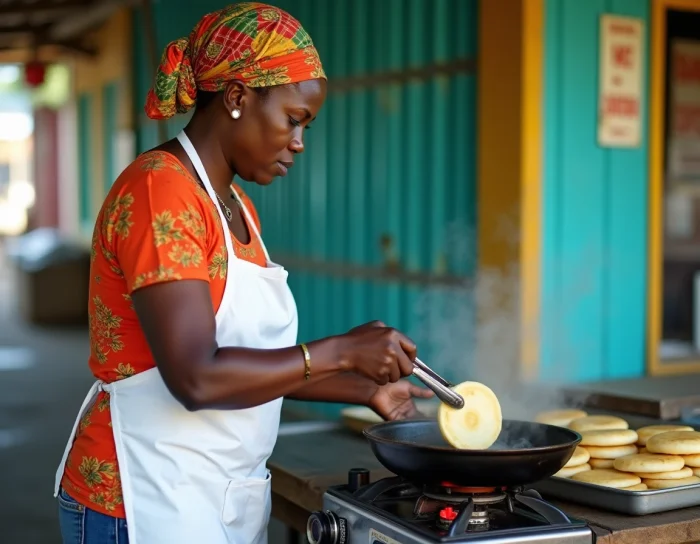
The dough itself varies. Some families make it thick for a softer interior, while others prefer it thin and crispy. The temperature of the frying oil and the cooking time significantly alter the final texture.

What standardization changes
When a bokit is prepared for a tourist clientele or in a food truck in the metropolis, the recipe tends to normalize. The dough is standardized, the filling predictable. This uniformity facilitates reproducibility, but it erases the micro-variations that made the bokit an artisanal product.
The parallel with other street foods that have become global is striking. The Vietnamese banh mi or the Mexican taco have undergone similar processes, where international recognition has led to a dilution of local versions in favor of an exportable format.
Authenticity of the bokit: a debate that reveals Caribbean culinary tensions
The question “what is a real bokit?” regularly arises in online discussions and on Caribbean social media. It concerns less the exact recipe than the legitimacy of those who prepare it and the context in which it is consumed.
A bokit bought at a roundabout in Pointe-à-Pitre and a bokit served in a specialized Parisian restaurant do not respond to the same logics. The former is part of an ecosystem of food trucks where the price remains accessible, between two and five euros depending on the fillings. The latter integrates a gastronomic positioning with a different pricing structure.
This distinction is not anecdotal. It touches on how a community perceives the appropriation of its cuisine. The bokit, born as a subsistence bread made with the simplest ingredients (flour, water, salt, oil), carries in its genesis a story of precariousness and inventiveness. Its transformation into a premium product raises questions of cultural justice that the mere historical narrative cannot address.
The debate on the culinary authenticity of the bokit reflects a broader dynamic in the French Antilles, where the heritage of Creole cuisine oscillates between identity pride and commercial appropriation. The difference between the two often hinges on a detail: who tells the story, and who benefits from the spotlight.