Since 2005, the order of surnames passed on to children is no longer a strict obligation in France. However, the law still allows for situations where the parents’ wishes clash with administrative constraints or the absence of consensus.
When a family is restructured, or a new chapter opens after a separation, the question of the surname arises with renewed urgency. Adapting a child’s name to the new family dynamic often resembles a puzzle, even when a simple adoption is involved. The procedures are regulated, sometimes winding, and the outcome closely depends on each person’s legal situation.
Understanding French rules on children’s surnames
Choosing a child’s surname, especially in the often fluid context of blended families, involves navigating between civil law and emotional realities. Since the 2005 reform, parents have been granted greater flexibility: they can give their child the father’s name, the mother’s name, or both, in the order of their choice. This freedom, seemingly straightforward, comes with safeguards. At the time of the birth declaration, the civil registrar ensures the chosen name, which will apply to all children from the same couple.
But when the family unit changes, through separation or restructuring, the name given at birth does not change automatically. For a child from a first union to bear a different name, a formal process must be initiated: changing a name follows a strict procedure, subject to the prosecutor’s discretion. Simple adoption opens the possibility of adding the new parent’s name, but the final decision rests with the judge, who always evaluates the child’s best interest.
To delve deeper into the subject, it may be useful to consult specialized resources, such as everything about hyphenated surnames. Understanding what a name represents in the journey of a child from a blended family also means grasping the attention given by French law to the unity of siblings and the clarity of civil status. For each family configuration, it is advisable to consider these principles as well as the unique history being written.
Blended families: what options for choosing a name?
In the landscape of blended families, the question of surnames reveals connections, sometimes highlights differences, and sheds light on the limits of the law. In France, the rule is clear: a child born from a first union retains the name listed on their birth certificate, unless a name change process is successfully completed. This procedure remains rare and depends on the agreement of the prosecutor.
Here are the concrete options available to parents in a new union:
- simple adoption by the new spouse, which allows for the possibility of adding their name to the child’s,
- the request for a name change for legitimate reasons, which requires a solid and convincing justification before the administration.
Many parents hope to give all the children of their blended couple a common name, symbolizing unity. In practice, this wish encounters regulatory hurdles: outside the mentioned procedures, the name cannot be changed. Family law primarily focuses on the stability of civil status and the continuity of parentage. In a blended family, it is therefore common for siblings to have different names, reflecting their history and journey.
In daily life, a solution exists: the name of use. This is a flexible social practice, without official value in civil status, but which allows the child to carry the name of the new parent in school or everyday life. This possibility, although not formalized, accompanies the diversity of situations in blended families in France.
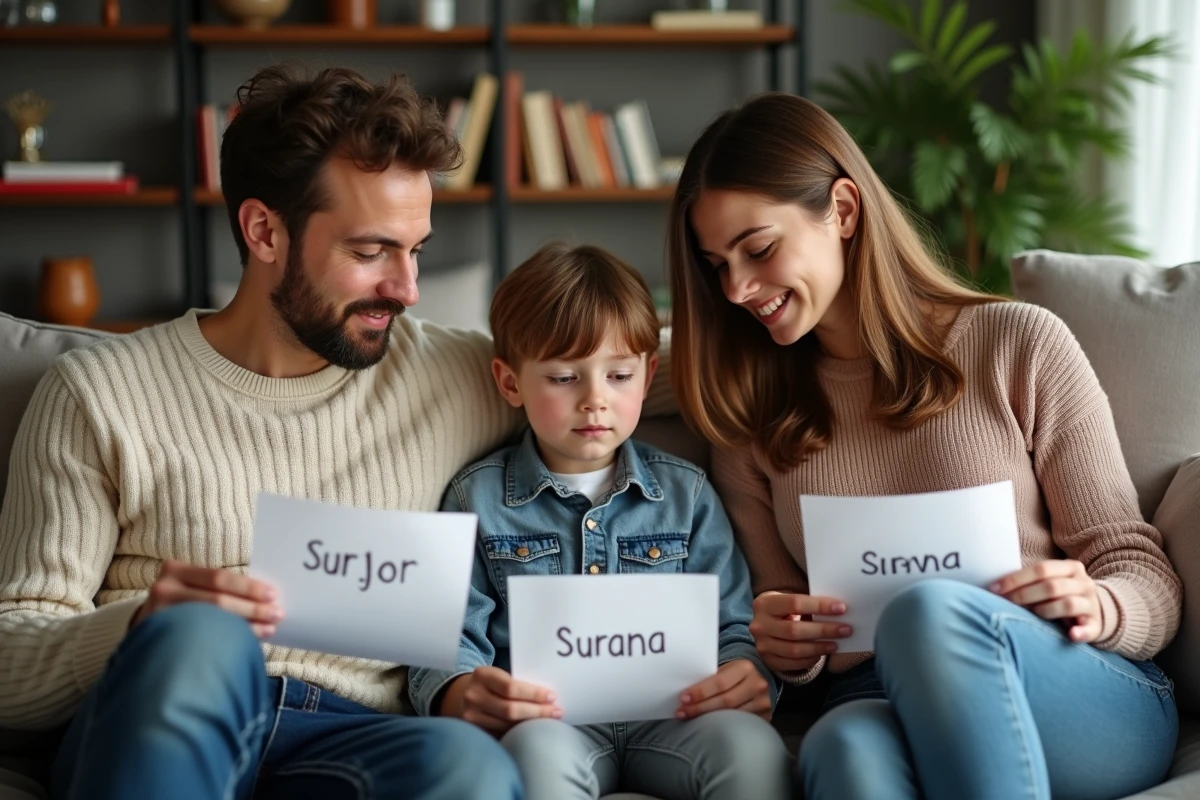
Surname and identity: supporting the reflection of parents and children
The surnames extend beyond the administrative sphere. They touch upon what shapes identity, constructed through bonds, separations, and new beginnings. In the context of a blended family, the choice of name engages an intimate dimension: it bears the mark of a history, that of the parents, that of the child, sometimes a desire to repair or to build differently.
For parents, the decision is never trivial. Between the desire to preserve original ties and the wish to place the child in a new dynamic, reflection is essential. The dialogue with the child then becomes central. Depending on their age and maturity, it is about explaining, listening, and giving meaning to the process. In France, the law also stipulates that a child over thirteen years old must give their consent for any name change. This is not a detail: it is the recognition of their voice in the construction of their identity.
In practice, many families seek the right balance: how to preserve multiple ties without blurring the belonging to the new unit? The name of use, even without legal value, sometimes offers a soothing solution. This choice is built through exchanges, according to each person’s sensitivity.
The diversity of situations highlights the usefulness of tailored support. Lawyers, advisors, and social workers specialized in family law can help clarify the stakes, anticipate the psychological effects for the child, and ensure the coherence of choices over time. In this area, each decision is part of the legacy of a unique story, where law and the intimate advance side by side.