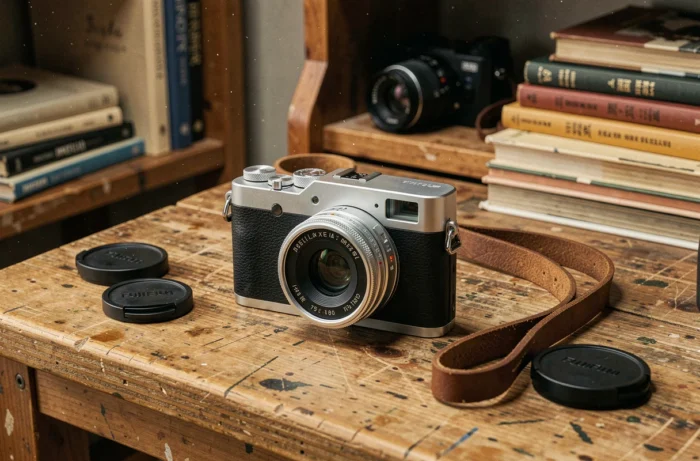
Launched at the end of 2012, the Fujifilm X-E1 is part of the first wave of APS-C sensor hybrids from the Japanese brand. It features the X-Trans sensor from its predecessor, the X-Pro1, but in a more compact body without the hybrid optical/electronic viewfinder. Several years after its release, this camera continues to circulate in the second-hand market and fuels discussions among photographers looking for an accessible Fujifilm hybrid.
X-Trans Sensor of the Fujifilm X-E1: What the Technology Really Changes
The X-E1 is equipped with the APS-C X-Trans sensor, an architecture that Fujifilm designed to stand out from the Bayer matrix used by almost all competitors. The arrangement of the red, green, and blue filters is more irregular, inspired according to Fujifilm by the structure of film grain. This design significantly reduces moiré, to the point that Fujifilm has removed the optical low-pass filter usually placed in front of the sensor.
In practice, the absence of a low-pass filter results in very high sharpness for a sensor of this generation. Fine details of textures (fabric, foliage, stones) stand out with a clarity that competing cameras from the same era struggle to match. The color rendering, often cited as a Fujifilm signature, relies on the built-in film simulations (Velvia, Astia, Pro Neg). These profiles remain usable directly in JPEG, without heavy editing.
For those who want to delve deeper into the results in the field, the test of the Fujifilm X-E1 camera details the sensor’s performance in various lighting conditions.

Autofocus and Ergonomics: The Concrete Limits of the Body
The autofocus of the X-E1 works by contrast detection. At its release, the responsiveness of the focus was regularly criticized, particularly in low light or with moving subjects. Compared to APS-C DSLRs from the same period, the focusing time remains noticeable.
Firmware 2.00 introduced focus peaking, a tool that displays a colored outline on the sharp areas in the viewfinder. This function, combined with the choice between 3x and 10x magnifications, has significantly improved the use of manual lenses. Before purchasing a second-hand unit, checking the installed firmware version is important: the latest version referenced by Fujifilm is 2.71, which fixes several stability and compatibility issues with Fujinon lenses.
The ergonomics of the body impose some compromises. The absence of a joystick requires navigating with the directional controls to move the focus frame. With a manual lens not recognized by the camera, it is also necessary to enable the release without lens option in the menus. These manipulations are not blocking, but they slow down the workflow compared to more recent models in the X range.
Electronic Viewfinder of the X-E1: A First-Generation Compromise
The OLED electronic viewfinder of the X-E1 has a resolution of 2.36 million dots. For its time, this figure placed the viewfinder among the best in the hybrid segment. The field coverage meets the expected standard, and the viewfinder allows for previewing exposure, white balance, and film simulations before shooting.
The limits appear in low-light scenes. The refresh rate of the viewfinder then generates a slight trailing effect on fast movements. Moreover, the transition from the viewfinder to the rear screen is not always smooth, with the eye sensor sometimes reacting with latency. These minor defects in posed photography or landscapes become bothersome for quick street photography or tracking moving subjects.
When the Electronic Viewfinder Becomes an Asset
For landscape, posed portrait, or still life photography, the electronic viewfinder offers a direct advantage: what you see in the viewfinder corresponds to the final file. Exposure, simulated depth of field, and color rendering are visible before the shutter is pressed. This operation reduces the number of shots needed and simplifies work in changing light conditions.
Second-Hand Fujifilm X-E1: What to Check Before Purchase
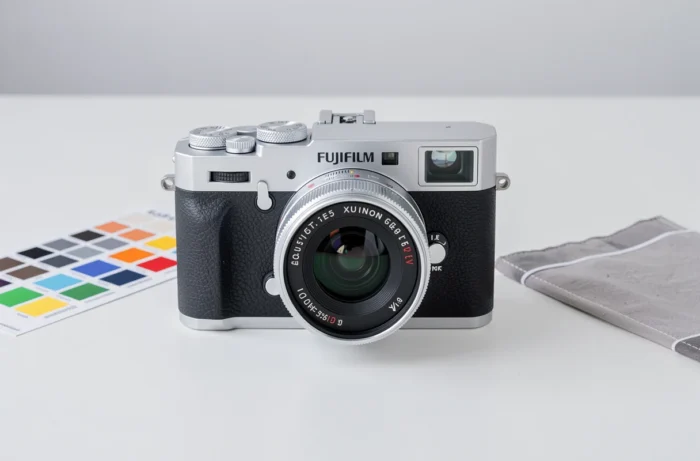
The X-E1 is available at prices significantly lower than those of current Fujifilm hybrids. Before finalizing a transaction, several points deserve attention:
- The firmware version: a camera that has remained on version 1.x does not offer focus peaking or compatibility corrections from later versions. The update to version 2.71 is downloadable from the Fujifilm website.
- The condition of the sensor: check for dust on the sensor by photographing a white surface at a small aperture. Sensor cleaning on an older body can represent a significant additional cost.
- The shutter count: a very high number of shutter actuations may indicate wear on the shutter mechanism, even though the mechanical reliability of the X-E1 is generally considered adequate.
- Compatibility with targeted lenses: some newer Fujinon lenses work on the X mount but do not benefit from all firmware optimizations on a first-generation body.
A well-maintained and updated unit remains a photographic tool capable of producing quality images, provided one accepts the limitations of an autofocus that is slower than current standards.
Fujinon Lenses and Manual Alternatives on X Mount
The Fujinon optical lineup is one of the strong arguments of the Fujifilm ecosystem. The XF 18-55mm f/2.8-4 zoom, often sold in a kit with the X-E1, far exceeds the usual performance of a kit lens. Its aperture range and sharpness make it a versatile companion for everyday use.
Third-party manual lenses work on the X mount with some adjustments in the camera menus. The focus peaking added by firmware updates makes this practice viable, even if the absence of a joystick slows down the repositioning of the focus point. For street photography or fixed focal portrait work, a bright manual lens paired with the X-E1 offers a cost-to-performance ratio that is hard to beat in the current market.
The Fujifilm X-E1 does not claim to compete with hybrids released a decade later. Its X-Trans sensor, film simulations, and the quality of the Fujinon optical lineup give it photographic relevance that transcends its age. A well-inspected second-hand body performs as well as a recent model for those who accept a slower autofocus and a first-generation viewfinder. The rest is photography.