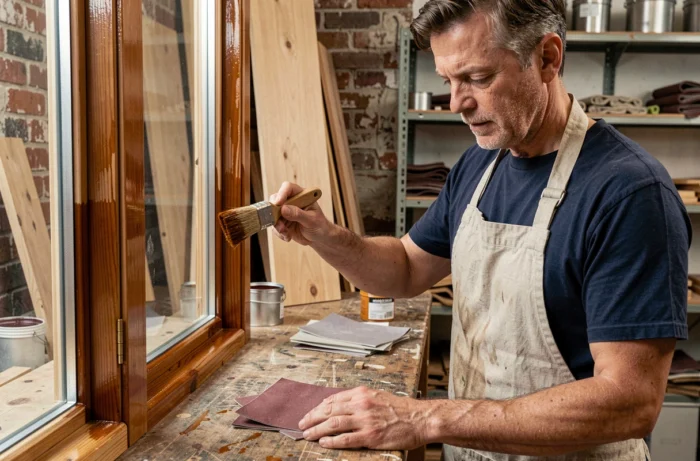
An oak shutter facing due south that starts to turn grey after two winters, a window frame whose finish peels off in patches: in both cases, the product used was not suited to the actual conditions the wood was exposed to.
Polyurethane wood stain promises a hard, durable film. But polyurethane resin alone is not enough to ensure long-lasting protection for exterior woodwork. Several technical factors, often missing from product labels, determine how well the finish will hold up.
Polyurethane wood stain for exterior woodwork: what the resin cannot make up for
Polyurethane is often associated with maximum protection. In reality, UV resistance depends less on the type of binder than on the product’s overall formulation—and, above all, its pigmentation.
Even a polyurethane-based clear stain lets a significant amount of ultraviolet radiation through. The wood turns grey, its surface fibres deteriorate, and the film eventually peels away. A tinted finish offers better protection than a clear one because the pigments absorb some of the UV rays before they reach the fibres.
Before buying, check two things on the technical data sheet: that the product is explicitly intended for “exterior” use and that it provides UV protection. A product that does not specify these properties is not designed for exposed woodwork, whatever its binder.
When choosing a polyurethane wood stain that will last, this formulation criterion matters more than the resin name printed in large letters on the tin.
Film flexibility and wood movement: the pitfall of exterior surfaces
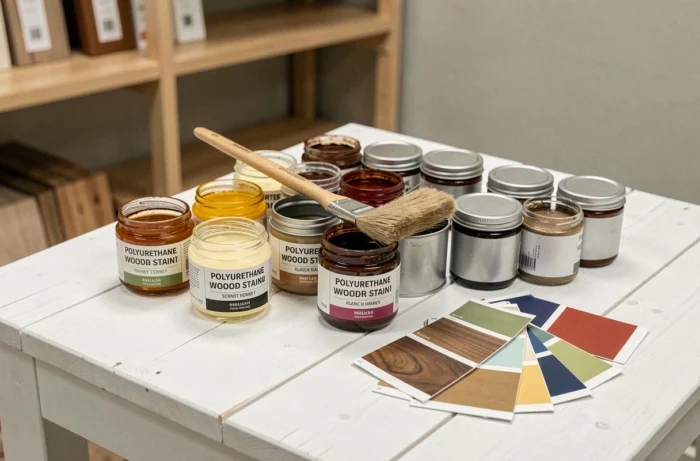
Wood is a living material. It swells in damp conditions and shrinks in dry weather. These dimensional changes put any film-forming finish under considerable strain—and polyurethane produces a hard film.
A film that is too rigid cracks when the wood moves. This is common on windows and shutters exposed to alternating rain and sunshine: hairline cracks appear, water seeps beneath the film, and the wood blackens from below. The result is worse than leaving the wood untreated, because moisture trapped beneath the coating can no longer evaporate.
Polyurethane formulations intended for exterior use contain plasticisers or modified resins that give the film a degree of flexibility. The technical data sheet may describe this property as “flexible” or “elastic”. If no such indication is given, the product is better suited to indoor furniture than to exterior cladding.
The distinction between vertical and horizontal surfaces also matters. On a deck or flat windowsill, water can pool and exert hydrostatic pressure on the film. Well-drained vertical woodwork puts less strain on the finish than a horizontal surface exposed to driving rain. Choose a product to suit the shape and orientation of the surface.
Polyurethane, acrylic or alkyd wood stain: practical comparison criteria
Comparing wood stains solely by film hardness gives an incomplete picture. In practice, three factors distinguish these product types.
- Ease of future maintenance: if a film-forming stain (polyurethane or alkyd) peels, the surface must be sanded back completely before refinishing. A wood saturator or microporous stain can be refreshed with a simple clean and a new coat. The cost of restoring the finish in a few years matters just as much as the initial price of the tin.
- Odour and drying time: water-based formulations (acrylic stains) dry quickly and release few volatile compounds. Solvent-based polyurethane stains create a harder film, but indoor application requires good ventilation and a longer drying time.
- Microporosity and wood breathability: a microporous stain lets water vapour escape from the substrate. A standard polyurethane film is less permeable. For interior woodwork (panelling, frames), this difference is negligible. For exterior cladding exposed to moisture, it can speed up deterioration if the wood is not completely dry when the product is applied.
Reading the label: claims that affect product durability
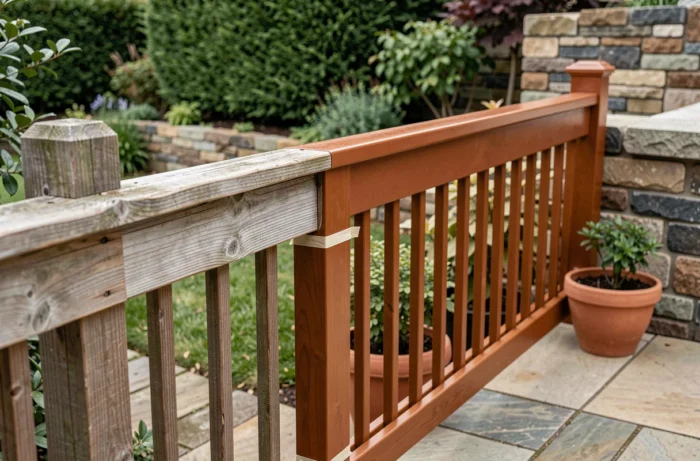
Marketing claims can make it hard to know what to look for. “High-protection wood stain”, “long-lasting finish”, “reinforced formula”: none of these terms is standardised. Focus instead on verifiable technical information.
The technical data sheet or label should clearly state the type of binder (polyurethane, alkyd, acrylic), the intended use (interior, exterior or both), the recommended number of coats and the coverage per coat. A product without a detailed technical data sheet is not worth the risk.
Colour directly affects protection. Transparent stains show the wood grain but provide less UV protection. Semi-transparent or opaque stains offer a more effective barrier. The aesthetic choice—natural or coloured finish—therefore has a technical impact on how often maintenance is needed.
Another often-overlooked point is environmental certification. Some certifications regulate volatile organic compound emissions, but they do not guarantee a product’s mechanical performance. An environmental label tells you about air quality, not the durability of the film.
Maintaining polyurethane wood stain: plan ahead before applying it
People rarely choose a wood stain with the day it will need replacing in mind. Yet this is what determines the true cost over the woodwork’s lifetime.
A film-forming polyurethane finish that ages poorly must be stripped or mechanically sanded to expose clean wood. On moulded shutters or multi-pane windows, this preparation accounts for most of the time spent on the job.
By contrast, a wood saturator or penetrating stain can be renewed without sanding: clean the surface, lightly sand it, then apply a new coat. The difference in cost and time between the two approaches is significant, especially when there are multiple surfaces to treat.
For lightly used interior woodwork (decorative panelling, door frames), polyurethane wood stain remains a sensible choice: its hard film stands up well to light scuffs and only needs dusting. For exposed exterior woodwork, consider future maintenance before buying—not after the finish starts to peel.