A masonry summer kitchen, covered by a solid pergola, connected to water and electricity: the project is appealing, but it places the owner at the crossroads of two distinct legal frameworks. Urban planning law sets the necessary permits based on the created surface area. Tax law, on the other hand, determines whether this surface generates additional taxation, whether through the development tax or property tax. Confusing the two amounts to addressing the problem halfway.
Aerial detection and summer kitchen: the concrete risk since Innovative Land
The General Directorate of Public Finances (DGFiP) has generalized the Innovative Land tool, an aerial imaging detection system initially deployed to identify unreported swimming pools. Its scope now extends to garden annexes, shelters, verandas, and any enclosed and covered construction visible from the sky.
A closed or semi-closed summer kitchen, with a fixed roof, falls within the scope of this surveillance. When the algorithm identifies a structure absent from the land registry, the DGFiP can demand a back payment of property tax for several years. The owner then receives a regularization notice, sometimes accompanied by late penalties.
The determining factor is not the culinary use of the construction, but its physical nature. A countertop placed under a removable awning will not be identified in the same way as a masonry room with a tiled roof. It is precisely the distinction between movable arrangements and construction in the sense of the urban planning code that guides the tax qualification. The tax regulations for summer kitchens are primarily based on this structural criterion.

Development tax on a summer kitchen: thresholds and triggering criteria
The development tax applies to enclosed and covered surfaces with a ceiling height of 1.80 m or more. The triggering threshold is set at 5 m² of created surface. These criteria, identical to those applied to garden shelters or verandas, apply to summer kitchens as long as they meet this dual condition: enclosed and covered.
In practice, three configurations stand out:
- A completely open kitchen (without walls, without lateral closure) does not fall under the development tax, regardless of its size. A fixed barbecue under a slatted pergola falls into this category.
- A covered but partially closed kitchen (one or two solid walls, the rest open) poses an interpretative problem. Local tax authorities assess on a case-by-case basis whether the construction can be considered enclosed.
- A kitchen closed on three or four sides, with a permanent roof and sufficient height, is taxable in the same way as a garden shelter or a veranda.
Field reports diverge on the treatment of semi-open kitchens. Some municipalities classify them as taxable annexes, while others exclude them. The Local Urban Plan (PLU) and the interpretation of the municipal instruction service play a decisive role in this gray area.
Property tax: the logic of cadastral rental value
Beyond the development tax (paid once after construction), the summer kitchen can also modify the cadastral rental value of the property. This value serves as the basis for the annual calculation of property tax.
Any additional built surface, declared or detected, leads to a reassessment. The owner must, in principle, report the construction via a declaration to the property tax office within 90 days of the completion of the work. In the absence of a declaration, it is aerial imaging or an on-site inspection that triggers the regularization, with retroactive payment.
Fines and demolition: what an unauthorized summer kitchen risks in 2026
The urban planning aspect has its own regime of sanctions, distinct from taxation. Building a summer kitchen without the required prior declaration or building permit exposes one to criminal and administrative prosecution.
Since 2026, administrative fines for unauthorized construction can reach several tens of thousands of euros. The municipality can also order the demolition of the structure if the owner refuses to comply. This tightening is part of a broader policy to combat illegal constructions in gardens.
The typical procedure follows a precise sequence:
- Detection of the violation by a sworn agent (or reporting via imaging)
- Formal notice to regularize or submit a retroactive authorization request
- In case of refusal to regularize, referral to the administrative court which may lead to an injunction for demolition under penalty
The risk is not limited to large constructions. A masonry kitchen of a few square meters, if fixed to the ground and covered, falls within the scope of control.
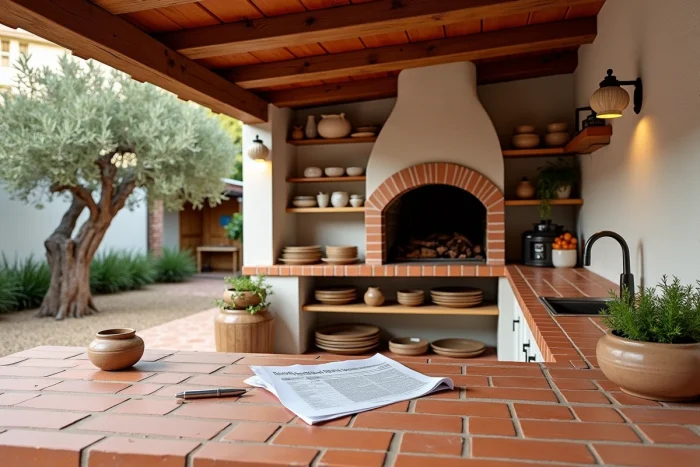
Modular summer kitchen and taxation: the option of a removable installation
In light of these constraints, some owners are turning to modular outdoor kitchens, meaning equipment that is not fixed to the ground, without foundations or permanent connections. This approach offers a direct tax advantage: a removable installation does not create taxable surface area.
For this qualification to hold, the installation must remain genuinely mobile. A module placed on a concrete slab, permanently connected to water and electricity, loses its removable character in the eyes of the administration, even if the manufacturer presents it as modular.
The criterion retained by urban planning and tax services converges: it is the fixation to the ground and the permanent nature that determine the legal nature of the installation. A plancha cart under a parasol will never be treated as a veranda. In contrast, a set of furniture fixed on concrete blocks, under a polycarbonate roof screwed to the house, falls into the category of constructions subject to authorization and taxation.
The boundary between outdoor arrangements and taxable constructions lies in technical details: anchoring, covering, lateral closure, height. Each fixed element added brings the summer kitchen closer to the tax regime of built annexes. Before pouring a slab or erecting a wall, checking the PLU of one’s municipality and consulting the urban planning service of the town hall remains the only step that truly protects against subsequent reassessment.