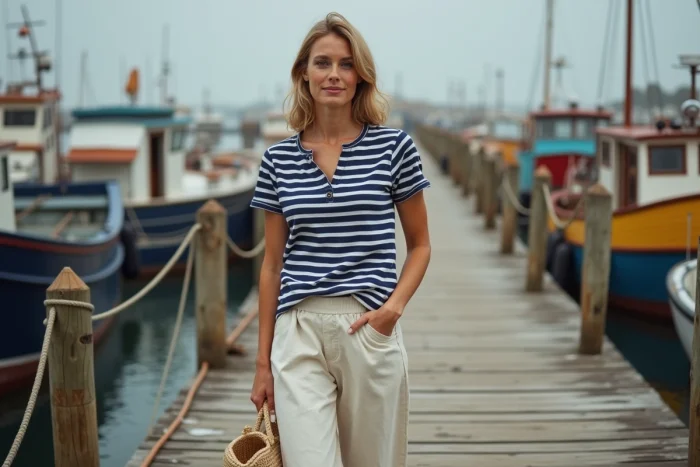
The nautical style is no longer just about slipping on a blue and white striped shirt with jeans. For the past two seasons, spring-summer collections have incorporated broader seaside codes: deck chair stripes, coastal embroidery, resort textures. This shift, documented by Hypebae in May 2026 through House of Sunny’s “Coastal” collection, signals a change in approach. The nautical style becomes a complete wardrobe vocabulary, embraced as much by visual networks as by runways.
Recycled mesh and certified cotton: materials redefining nautical clothing
The issue of materials is the blind spot of most articles on nautical fashion. There is talk of stripes, blazers, colors, but rarely of the fabric itself. House of Sunny’s “Coastal” collection highlights recycled mesh and more sustainable cottons, designed to last beyond a single season.
This shift towards responsible materials changes how one chooses a nautical piece. A nautical sweater made from wool blended with recycled polyester does not have the same impact as a classic acrylic sweater. Similarly, linen grown without excessive irrigation or certified cotton alters the environmental footprint of a striped dress or pants.
For those who wish to explore these reimagined nautical pieces, it’s possible to access the fashion page of My Fish Book and compare the approaches of different brands in this niche.
Technical finishes accompany this movement. Reinforced seams, more stable dyes, and sufficiently dense weights to withstand repeated washes: durability becomes a criterion of style as much as of quality. A nautical garment that deforms after three wears fails its purpose, regardless of its pattern.
Nautical style beyond the striped shirt: pieces that make up a complete look
The striped shirt remains a safe bet, but the nautical vocabulary has expanded. Recent collections show that seaside style is now built around several categories of pieces, each with its own codes.
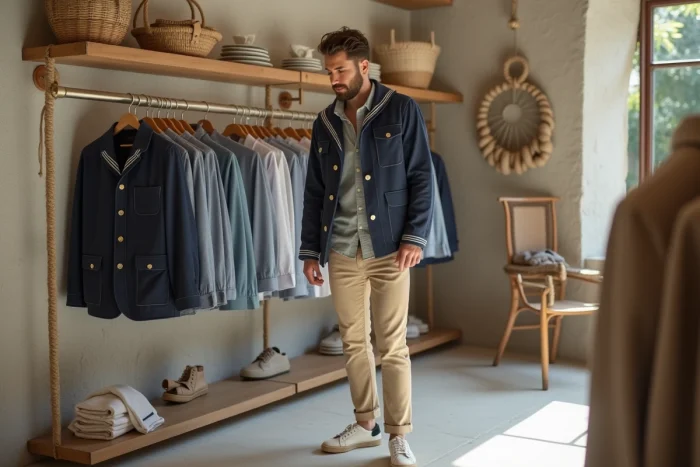
- The cotton or linen blazer, often in navy blue or ecru tones, replaces the classic jacket for a structured look without rigidity. Worn over a flowing dress or wide pants, it anchors the silhouette in a nautical register without being overdone.
- The wide striped dress (deck chair style) takes over from the traditional fine-striped shirt. Colors extend beyond the white and blue duo: brick red, mustard yellow, and sage green appear in recent offerings.
- Pieces in openwork or mesh, worn in layers, add a textured dimension that evokes fishing nets without falling into costume. This style was absent from nautical collections just two years ago.
- The nautical sweater in thick wool or cotton, worn over the shoulders or tied at the waist, remains a classic transitional piece. Its cut and weight matter more than its pattern.
The assembly of these pieces creates a nautical look that no longer depends on a single iconic garment. Style is built through the accumulation of textures and colors, not by a unique pattern.
Pinterest trend and dissemination through visual networks: how nautical style circulates today
Nautical style is among the micro-trends identified on Pinterest for 2025, according to data shared by Elle.fr. This dissemination channel changes the very nature of the trend. On Pinterest, nautical style is presented in the form of mood boards, piece associations, and color palettes, not as commented runway shows.
This visual circulation favors composite looks rather than signature pieces. A Pinterest user pins a navy blazer, a white linen dress, strappy sandals, and reconstructs a personalized nautical wardrobe. The trend spreads through individual curation, which explains the diversity of interpretations observed.
Field feedback diverges on this point: some creators believe that this dissemination through visual networks dilutes the identity of nautical style, while others see it as a democratization that distances the trend from its luxury roots. The available data does not allow for a definitive conclusion, but the volume of Pinterest pins related to the keyword “nautical style” has evidently increased in recent months.
Responsible nautical fashion: what a sustainable purchase really means
Displaying “responsible” on a label is not enough. A sustainable nautical garment meets concrete criteria that go beyond the simple choice of material.
The longevity of a piece depends as much on its cut as on its fabric. A nautical sweater that is too fitted will deform faster than a straight cut. A poorly lined linen dress will wrinkle to the point of becoming unwearable without regular ironing. These design details determine whether the garment will be worn thirty times or three times.
Colors also play a role. Natural or Oeko-Tex certified dyes withstand washes better than low-quality dyes. A navy blue that turns gray after a few washes disqualifies the piece, regardless of the origin of its cotton.
On the other hand, high price does not automatically guarantee quality. Some brands positioned in the nautical niche charge a premium for image without the garment’s construction justifying it. Checking seams, fabric density, and color retention after washing remains more reliable than relying on price positioning.
Nautical style endures through the decades because it is based on simple pieces and readable visual codes. Its recent evolution towards recycled materials, more varied silhouettes, and dissemination through visual networks gives it a new dimension. Choosing well-constructed and durable nautical pieces remains the best way to adopt this trend without contributing to textile overproduction.