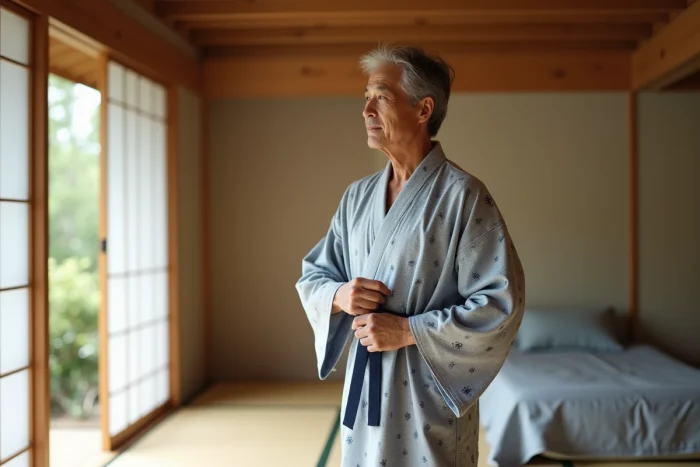
A regulation displayed at the reception. A carefully folded pajama on the bed, accompanied by an explanatory sheet. And sometimes, the clear instruction: here, everyone wears the same outfit to move through the corridors, access the baths, or sit down for breakfast. No exceptions for foreign visitors, no distinctions for weekend Japanese guests. The provided outfit becomes the silent passport of the stay, balancing etiquette and an invitation to let go.
Some traditional accommodations impose specific rules, requiring the wearing and use of these garments for every movement outside the room. Others simply incorporate the pajama into the routine, offering an extra layer of comfort without making it mandatory. One then shifts from an almost ceremonial version to a more flexible proposition, depending on the type of establishment: ryokan, minshuku, contemporary hotel… Each variant tells another facet of traveling in Japan, far beyond aesthetics or mere well-being.
The Pajama in Japanese Hospitality: Between Cultural Heritage and Enjoyment of the Stay
In the cozy world of Japanese hotels, the pajama is not just about a peaceful night. It embodies a unique form of hospitality where every detail matters. Worn in the room, but also in the corridors or common lounges, it reflects the care given to comfort and conviviality. Whether in the form of a yukata, a jinbei, or a kimono-style robe, this garment extends a story where tradition and adaptation naturally find their place.
The custom of pajamas in Japanese hotels does not merely flatter the taste for folklore. It is part of daily life: a room with tatami, a futon ready to unroll, the touch of cotton or linen against the skin. The patterns, whether depicting waves, sakuras, or stylized cranes, carry strong symbolism, almost always explained by the host family or on a small brochure placed at the entrance. In some ryokan, putting on the pajama becomes a shared gesture, a suspended moment that connects the traveler to the guesthouse, in a form of mutual respect, silent and warm.
A Garment at the Border of Public and Private
Allowed in common areas, accepted during movements within the establishment, the Japanese pajama blurs the boundaries. In a ryokan, one does not simply sleep: one temporarily adopts a tradition, immerses oneself in a different rhythm. This garment, both a collective uniform and an individual marker, accompanies slowness, the art of pause, the attention given to simple gestures. The custom of pajamas in Japanese hotels fits into a logic where comfort mingles with a codified hospitality, without ostentation or rigidity. It offers another entry point into Japanese life, far from clichés, but always attentive to the visitor’s well-being.
Ryokan, Minshuku, Modern Hotels: What Are the Differences in Sleep Experience?
From ryokan to capsule hotels, each type of accommodation shapes its own relationship with sleep and nighttime comfort.
In ryokan, going to bed is almost a ritual. One settles into a room lined with tatami, the futon is discreetly unrolled by the staff, and the yukata awaits on the futon. Here, it is not just about spending the night: one is initiated into a way of life, from the bath in the onsen to walking through the corridors, always dressed in the provided outfit. This garment extends the immersion, from the hot bath to breakfast, creating continuity between the intimate and collective space.
The minshuku, family-run inns, offer a more stripped-down approach. Pajamas are not always provided: sometimes everyone brings their own outfit. The focus then shifts to sharing, communal meals, and direct relationships with the hosts. One finds a more spontaneous warmth here, less burdened by codes, but equally committed to Japanese conviviality.
In modern hotels, the experience aims to be more universal. The pajama, often made of cotton or synthetic fabric, is part of the standard equipment. Capsule hotels emphasize practicality: a minimalist garment for an express night, in a streamlined space. Tradition fades, but the desire to offer a pleasant stay remains, even in major cities like Tokyo.
| Accommodation | Pajama Provided | Atmosphere |
|---|---|---|
| Ryokan | Yes (traditional yukata) | Authenticity, immersion, ritual |
| Minshuku | Sometimes | Family, simplicity, warmth |
| Modern Hotel / Capsule Hotel | Yes (standardized) | Practicality, anonymity, urban comfort |

Choosing the Right Accommodation in Japan According to Your Desires and Expectations
The style of accommodation in Japan influences the entire experience. Many travelers eager for tradition opt for a ryokan, drawn by the promise of complete immersion. One finds the yukata in cotton, tatami floors, shared baths, and the tranquility of a minimalist room. The night on a futon, attentive service, the muffled silence: everything invites one to take a step aside to touch a way of life passed down through generations.
For those seeking exchange and simplicity, minshuku open their doors. The family atmosphere, communal meals, and the option to wear a jinbei contribute to this feeling of closeness and human warmth.
In large cities like Tokyo or Osaka, the hotel offerings are vast and varied. Modern hotels provide standardized pajamas, rooms optimized for urban living, with rates fluctuating according to demand. For a quick stop, capsule hotels attract with their efficiency, strategic locations, and adjusted prices.
Here are some tips to make the most of your stay:
- Plan your booking in advance, especially during tourist seasons when spots fill up quickly.
- Always compare rates in yen and examine options like the Japan Rail Pass to optimize your budget.
- Consider specialty shops or online sites to bring back a yukata or a kimono robe as a souvenir, to slip into your suitcase before returning to France.
Choosing where to sleep during a trip to Japan offers the chance to experience multiple atmospheres: the serenity of a night on tatami, the warmth of a family table, or the energy of a bustling city center. With each pajama, there is a way to inhabit the country, for the duration of a timeless stay.