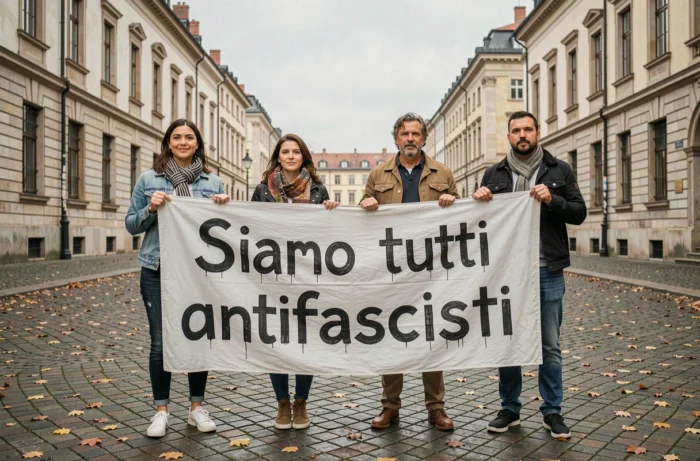
The slogan “Siamo tutti antifascisti” can be heard in Italian marches, but also in the streets of Strasbourg or in front of the Sorbonne in Paris. This phrase, which literally means “We are all antifascists,” circulates well beyond Italy. Its translations into French raise a concrete question: how to convey the word “tutti” without excluding part of the collective it claims to gather?
The translation problem posed by the word “tutti” in French
In Italian, “tutti” is a masculine plural that functions as a generic term. It refers to the whole of a group, regardless of the gender of the people that make it up. French has a direct equivalent: “tous”.
The difficulty arises when we question this generic term. “Tous” makes the presence of women in the collective invisible. This has been a long-standing criticism in French linguistics, but it takes on particular significance in a political slogan chanted at a demonstration.
Translating “Siamo tutti antifascisti” as “Nous sommes tous antifascistes” amounts to reproducing the same grammatical convention. Inclusive variants seek precisely to challenge it, by proposing forms that explicitly name the people that the masculine generic absorbs. This choice of translation is never trivial: it says something about the political vision of the collective that adopts it.
To delve deeper into the history of these linguistic adaptations, Perspective Media’s content details each variant and its context of appearance.
Inclusive translations of the antifascist slogan: French and Italian forms
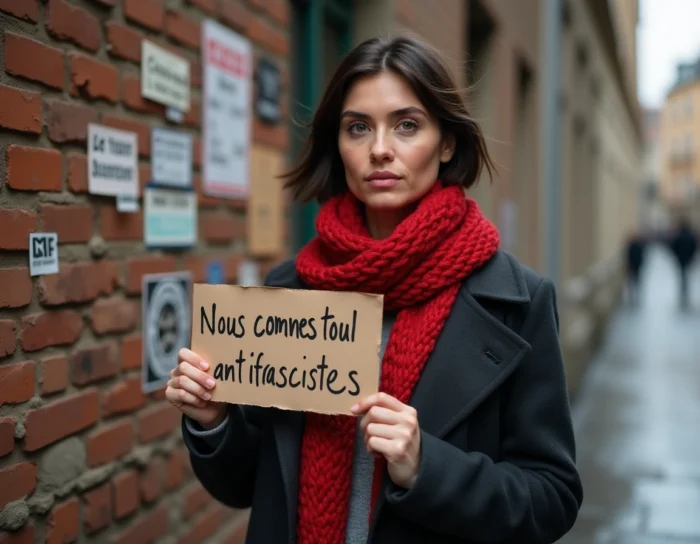
The variations of the slogan are not limited to a midpoint inserted between two letters. Each form carries a distinct linguistic project.
Complete feminization
The Italian form “Siamo tutte antifasciste” and its French equivalent “Nous sommes toutes antifascistes” do not aim for the inclusion of all genders. They make a politically explicit female subject visible. This variant asserts that women engaged in antifascism exist as an autonomous group, not as a subset of a default male collective.
The midpoint and its oral limitations
“Nous sommes tou·tes antifascistes” is the most widespread form in French leaflets and militant publications. The midpoint works well in writing. It signals a desire to include beyond the male-female binary.
However, the midpoint remains a graphic convention that is difficult to pronounce in a march. Chanting “tou-point-tes” at a demonstration does not work. This is why another form has emerged.
The neologism “toustes”
“Nous sommes toustes antifascistes” proposes a pronounceable contraction of “tous” and “toutes”. This form has the advantage of being vocalizable: it can be shouted, sung, or chanted in unison. It circulates mainly in French-speaking activist circles that practice inclusive writing on a daily basis.
Radical Italian forms: “tuttx” and “tutt*”
In Italy, the spellings “tuttx” and “tutt*” replace the final vowel (gender marker in Italian) with a neutral character. These forms remain confined to militant writing and pose a comprehension problem outside the circles that use them. Pronouncing them out loud relies on shared convention, not common language.
- “Tutte antifasciste”: complete feminization, visibility of women as an autonomous political subject
- “Tou·tes antifascistes”: broad graphic inclusion, but limited to writing
- “Toustes antifascistes”: pronounceable form, designed for marches and speeches
- “Tuttx / tutt*”: radical gender neutralization, understandable mainly in Italian militant circles
Why the slogan circulates between Italy and France
The slogan “Siamo tutti antifascisti” is not confined to the commemoration of April 25 in Italy, the anniversary of the end of the fascist regime. It travels.
In Strasbourg, French students have taken it up during recent demonstrations. In Paris, it resonated in front of the Sorbonne. The slogan functions as a transnational political language, understood without translation by demonstrators who do not speak Italian.
This circulation can be explained by the simplicity of the phrase and its historical anchoring. The word “antifascisti” is transparent for a French speaker. The structure (subject + verb + attribute) is identical in both languages. And the European political context, marked by the rise of far-right parties, gives the slogan a relevance that transcends Italy.

In Italy, the current government is regularly accused of failing to honor the duty of antifascist memory. The episode of the censorship of the text by writer Antonio Scurati on RAI, which was canceled before its broadcast, illustrates this tension. Recent mobilizations in Milan, where high school students, university students, unions, and representatives of the ANPI marched together, show that the slogan remains a concrete tool for gathering.
Antifascism and inclusive language: a political choice, not just grammatical
Choosing between “tous”, “toutes”, “tou·tes” or “toustes” in the translation of the slogan amounts to taking a stance on two related questions.
The first concerns language. Accepting or rejecting the masculine generic is deciding whether grammar can (or should) reflect political equality. Supporters of inclusive writing believe that language shapes thought. Their opponents argue that the generic is neutral by convention.
The second question concerns the very definition of antifascism. A feminized slogan (“toutes antifascistes”) explicitly links the antifascist struggle to feminist battles. An inclusive writing slogan (“toustes”) opens it to queer struggles. Each variant redraws the contours of the collective that declares itself antifascist.
This debate is not abstract. In marches, the choice of one form over another signals belonging, sensitivity, and positioning within the movement. The slogan remains the same in its intent, but its translations convey different meanings about those who carry it.
The phrase “Siamo tutti antifascisti” retains its rallying power precisely because it lends itself to these rewritings. A slogan that transforms according to the struggles it accompanies is a living slogan, not a fixed monument.